

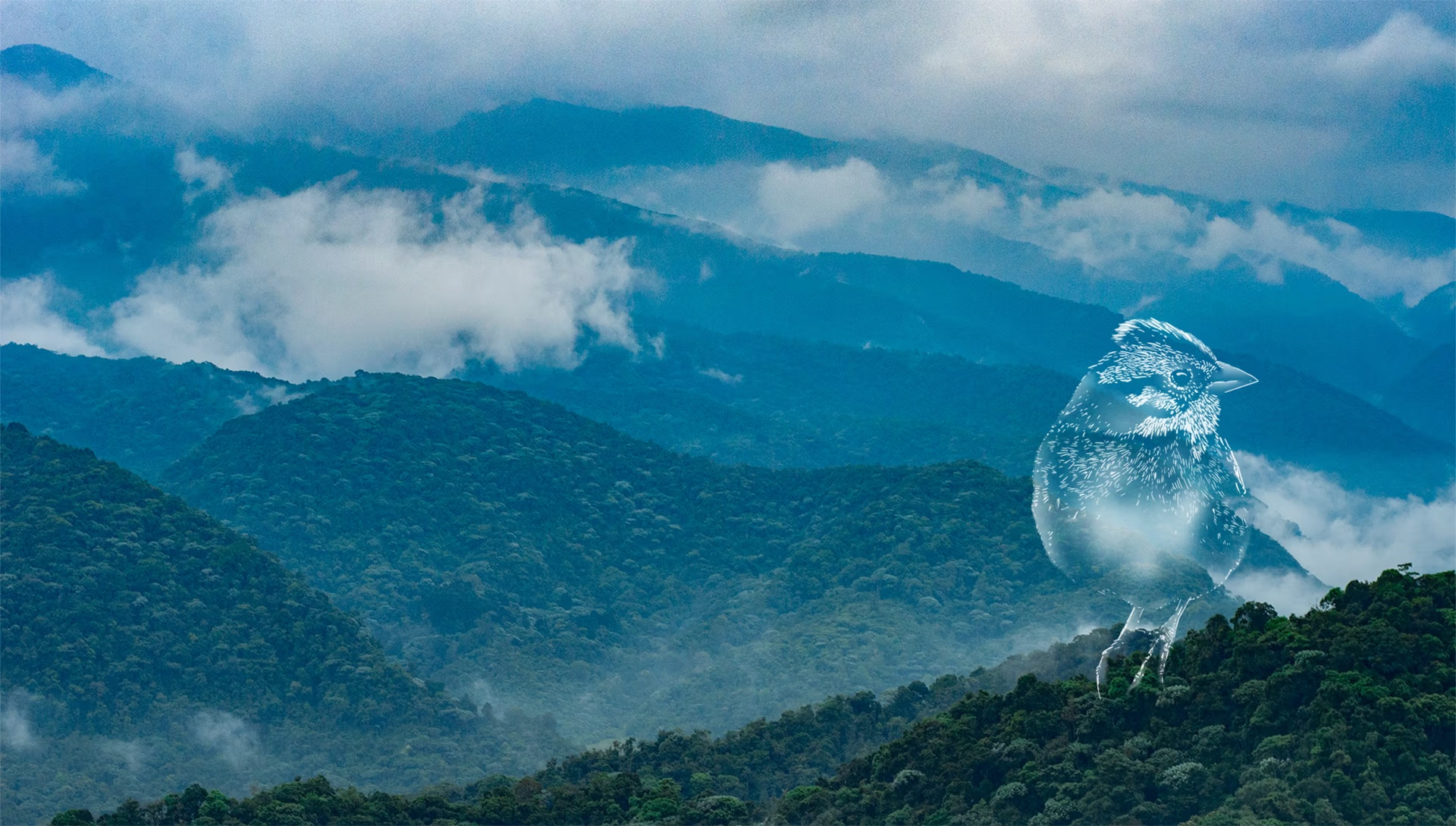
Translucent bird illustration perched over misty Andean cloud-forest mountains

The First Echo: How Wisdom Broke Free from Time

Origin Stories

The birth of ancient wisdom through the collision of mortal curiosity and eternal truth

In the time before memory learned to speak, the world breathed in perfect silence. Stars wheeled overhead, unmarked by names or stories, while oceans crashed against shores that had never known the footprint of questioning minds. The people of this primordial realm lived as shadows live—present but unaware of their own existence, moving through cycles of sun and moon without wonder, without the terrible gift of asking why.

It was Lyra who first heard the singing. Not with her ears, for the sound came from somewhere deeper than flesh—a crystalline resonance that seemed to emerge from the very stones beneath her feet. Others passed the same weathered cliff face daily, but only she paused, drawn by something that made her chest tight with unnamed longing. There, embedded in the ancient rock like frozen starlight, lay fragments of something impossible: thoughts made solid, memories crystallized into geometric perfection. As her fingers traced their surface, the world held its breath. For in touching them, she had awakened something vast and patient that had been waiting since the first dawn—waiting for a mind curious enough to break the sacred silence.

The Silence Before Knowing

In those distant days, the world wore silence like a shroud. Beings moved through their existence as sleepwalkers, tending fields they could not name, breathing air they never questioned, living lives that passed like shadows across unmarked stone. They knew hunger and satisfaction, warmth and cold, but never asked why the sun rose or where dreams came from when they closed their eyes.

Lyra was different. Where others saw only rock, she saw patterns. Where others felt only wind, she sensed whispers of something greater. Her restless mind reached toward mysteries that had no names, her heart aching with questions that had never been spoken aloud. It was this hunger that led her deep into the Forgotten Caves, where ancient stone held secrets older than memory.

There, embedded in walls that seemed to pulse with their own light, she found them—crystallized fragments that sang to her curious spirit. Each piece contained impossible geometries of thought, memories that belonged to no living thing, wisdom compressed into forms that made her mind reel with recognition of truths she had never learned. As her fingers touched the first fragment, something vast and patient stirred in the depths of creation, sensing at last a mind ready to receive what had been waiting eons to be found.

The Great Unraveling

The moment Lyra’s fingers lifted the last crystal from its ancient bed, the world convulsed. What had slumbered in scattered silence across countless eons suddenly stirred, drawn by her awakened mind like iron filings to a magnet. Across the realm, other fragments buried in mountain hearts and ocean depths began to pulse with terrible light. The dormant wisdom of vanished beings—thoughts that had crystallized at the moment of their transcendence—now sought reunion with desperate hunger.

Lyra screamed as knowledge flooded her unprepared consciousness. She experienced the birth of stars, the weight of civilizations, the mathematics of eternity. Her fellow beings, touched by the expanding wave of awakening, collapsed in terror as their simple minds encountered concepts that had no names, truths that burned like acid through their innocent awareness. The very air grew thick with invisible presence as ancient intelligences, long dissolved into pure thought, pressed against the barriers between dimensions. They had waited so long for a mind curious enough to receive them, but now their eagerness threatened to shatter the vessel they had chosen. Wisdom, unbound and raw, was a force too mighty for mortal flesh to contain.

The Sacred Binding

As Lyra’s mortal form began to fracture under the weight of infinite knowledge, the air itself seemed to shimmer and part. From spaces between moments, figures emerged—tall beings of luminous silver, their eyes holding the gentle depth of starlight reflected in still water. The Weavers, as they would come to be known, moved with purposeful grace toward the collapsing girl. “Child of questions,” spoke their leader, voice like wind through ancient trees, “you have opened what was meant to be shared, but slowly, carefully.”

With hands that seemed to be made of condensed moonlight, they began to work. They drew the raw, burning wisdom from Lyra’s overwhelmed mind, their fingers dancing through the air as if working an invisible loom. The chaotic flood of knowledge began to transform. Infinite truths were woven into stories that mortals could carry. Abstract concepts became symbols that could live in memory. The crushing weight of cosmic understanding was braided into teachings that would unfold gently across generations. As the Weavers worked, Lyra felt her mind clearing, the unbearable pressure easing into something precious and manageable—the first seeds of what would become ancient wisdom.

The Revelation

As the last threads of wisdom settled into teachable form, Lyra understood the profound truth that had eluded her: the crystallized fragments were not relics of some forgotten race, but seeds planted by consciousness itself at the dawn of existence. The cosmos, in its infinite loneliness, had scattered pieces of its own awareness across countless worlds, waiting for curious minds to find them and give them voice.

She was not the first seeker—across the vast expanse of time and space, others like her had awakened these same fragments, each becoming a bridge between eternal truth and mortal understanding. The ancient wisdom was never ancient at all; it was timeless, recreated anew each time a questioning spirit dared to reach beyond the veil of ignorance. As Lyra walked back toward her village, carrying the first stories humanity would ever tell, she smiled knowing that somewhere, in another world, another seeker was just beginning to wonder why the stars seemed to whisper her name.
Blue misty mountain ridges at dawn

Dance of Life

Natural Swing

The origin of life is not merely a biological event, but a sacred act of co-creation. From an ancestral perspective, the cosmos not only gave birth to matter, but also sowed an intention: to inhabit itself. Life emerges as a dance of the primordial elements: Earth, which gave us form and anchored us; Water, which flowed as the first emotion and the blood of all living things; Air, which gave us the breath of consciousness; and Fire, the spark of passion and the energy for transformation. Together, these elements did not simply create a body, but a home for the spirit.

In this narrative, nature is not a passive backdrop, but the teacher and guardian of that home. Its purpose is not to serve human beings, but to sustain a delicate balance that allows life to flourish in all its forms. Rivers teach us about persistence and change; trees, about patience and interconnection; seeds, about resilience and potential. Every organism, from the microscopic to the largest, fulfills a vital function in this sacred tapestry.

Thus, the purpose of nature is profound: to be a mirror of our own essence and a manual for living in harmony. It reminds us that true knowledge is not found only in books, but in the attentive observation of its rhythms. To understand this is to rediscover that the care of life is not an obligation, but a way to honor the sacred origin we share with the universe.

Dense green forest hills covered in mist

The Memory of the Seed

Documentary video script

Duration: 8-10 minutes

[00:00 – 01:00] Introduction: The Seed Conspiracy

(Mysterious, low-intensity Andean music. Black-and-white archive footage from 1940s America of conventional farm fields. We see scientists in laboratories handling test tubes. Then a cut to a farmer in Colombia, seen from behind, looking out over a monoculture field.)

NARRATION: To understand why a farmer in Arkansas was killed by a chemical, we must understand a story that did not begin with poisons, but with the promise of a science. An account of how a chemist’s curiosity about killing the poison ivy in his garden became a tool of global control, and of how that control reached our Andean mountains. It is not the story of a crime, but of how the memory of the earth was stolen by those who believed themselves its owners.

[01:00 – 03:00] Chapter 1: The Magic of Organic Co-evolution

(Cheerful, curious music. Animations with playful graphics that simply explain the natural evolution of a seed. Shots of a native forest in Colombia, showing a great diversity of plants and animals.)

NARRATION: Let us imagine the seed, that tiny point of potential, not as an inert object but as a time capsule. For millions of years, nature has worked as the best genetic engineer, with no laboratories and no chemicals. Through a process called co-evolution, plants, insects, animals and soil have adapted to one another. The caterpillar learns to eat certain leaves, the plant develops defenses against the caterpillar, yet at the same time creates a nectar that feeds the bees. It is a dance of trial and error, in which every living being adapts and refines itself to live in harmony with its surroundings.

(Animated graphics showing how plants adapt to the different soils, climates and pests of a specific region. The NARRATOR’s voice becomes more pedagogical and playful.)

NARRATION: The ancestral farmers of the Andes knew this. They did not invent agriculture; they learned from nature. They saved the seeds of the strongest plants, those that withstood drought or pests, and so, from generation to generation, the seeds grew wiser. The seeds learned to live in that territory, to understand its climate and to speak with its soil. It was a sacred pact, an inheritance of biodiversity that nobody needed to patent.

[03:00 – 05:00] Chapter 2: Chemical Interference and the Death of the Ecosystem

(Dramatic, suspenseful music. Archive footage from 1950s America of the Monsanto factory, the infamous Nitro accident, and the later introduction of Agent Orange in Vietnam.)

NARRATION: But one day, man decided he could speed up the process. He wanted to eliminate the “hard part” of farming: the weeds. With the invention of herbicides such as 2,4-D and glyphosate, a new era of industrial agriculture began. These chemicals promised miracles: clean fields without the effort of plowing and without long days of work. On the labels, they were said to be “safer than table salt.” But history soon proved otherwise.

(Shot of contaminated soil. An animated graphic shows how the chemicals not only kill the “weeds” but also destroy the soil microbiomes, the invisible heart of fertility.)

NARRATION: Just as glyphosate destroys a plant’s chemical pathway, industrial chemicals destroy the intelligence of nature. They kill the soil microorganisms, the ones that transform organic matter into food available to plants. It is as if the soil lost its “teeth” and could no longer eat on its own. Plants become dependent, as if they were in an intensive care unit, and farmers are forced to buy more chemicals to keep them alive. In this model, the wisdom of the earth is replaced by a chemical formula.

[05:00 – 07:00] Chapter 3: The Monopoly and the Struggle of the Andean Seed

(Tense, intriguing music. Images of contracts with fine print. The NARRATOR’s voice becomes more serious.)

NARRATION: The second part of the story was even more insidious. The industry’s solution to its own chemicals was the transgenic seed. They genetically modified seeds to be resistant to their herbicides, creating a perfect monopoly. They sold the seed and the poison, forcing farmers to sign contracts that prevented them from saving or sharing their own seeds. The consequence? Farmers lost their autonomy, their ancestral wisdom, and the diversity of their crops was lost in favor of a single product, a single poison, a single owner.

(Images of peasant communities in the Colombian Andes. The sound of a condor in flight and the wind among the trees.)

NARRATION: The battle for the seed is not a distant problem from another country. It is a problem lived in our Andean mountains. Industrial agriculture has affected our communities, has degraded our soils and has put the memory of native seeds at risk. But amid this chaos, a network of resistance has emerged, an alliance of seed guardians and farmers who refuse to forget.

[07:00 – 09:00] Closing: The Living Memory

(Music of hope and gentle triumph. Images of a community seed bank. An elderly woman teaches a young woman how to identify a seed. A group of children paint in a farm field. Images of the diversity of plants and animals returning to a healthy ecosystem.)

NARRATION: The wisdom that unites us is simple: nature does not need us to correct it; it needs us to listen to it. By caring for the seed, the land and the water, we are not only recovering biodiversity but also our own health. We are returning to an agriculture that is more than a job; it is an act of art, of spirituality and of community. The memory of the seed is alive in the hands of those who sow and tend it. Because in the end, the seed we plant is not only to feed the body, but to water history and cultivate a new way of life.

(Final shot of a handful of diverse seeds, against the backdrop of the Andes mountain range.)

THE END