

 Cart is empty
Documentary video script
Duration: 8-10 minutes
[00:00 – 01:00] Introduction: The Seed Conspiracy
(Mysterious, low-intensity Andean music. Black-and-white archive footage from 1940s America of conventional farm fields. We see scientists in laboratories handling test tubes. Then a cut to a farmer in Colombia, seen from behind, looking out over a monoculture field.)
NARRATION: To understand why a farmer in Arkansas was killed by a chemical, we must understand a story that did not begin with poisons, but with the promise of a science. An account of how a chemist’s curiosity about killing the poison ivy in his garden became a tool of global control, and of how that control reached our Andean mountains. It is not the story of a crime, but of how the memory of the earth was stolen by those who believed themselves its owners.
[01:00 – 03:00] Chapter 1: The Magic of Organic Co-evolution
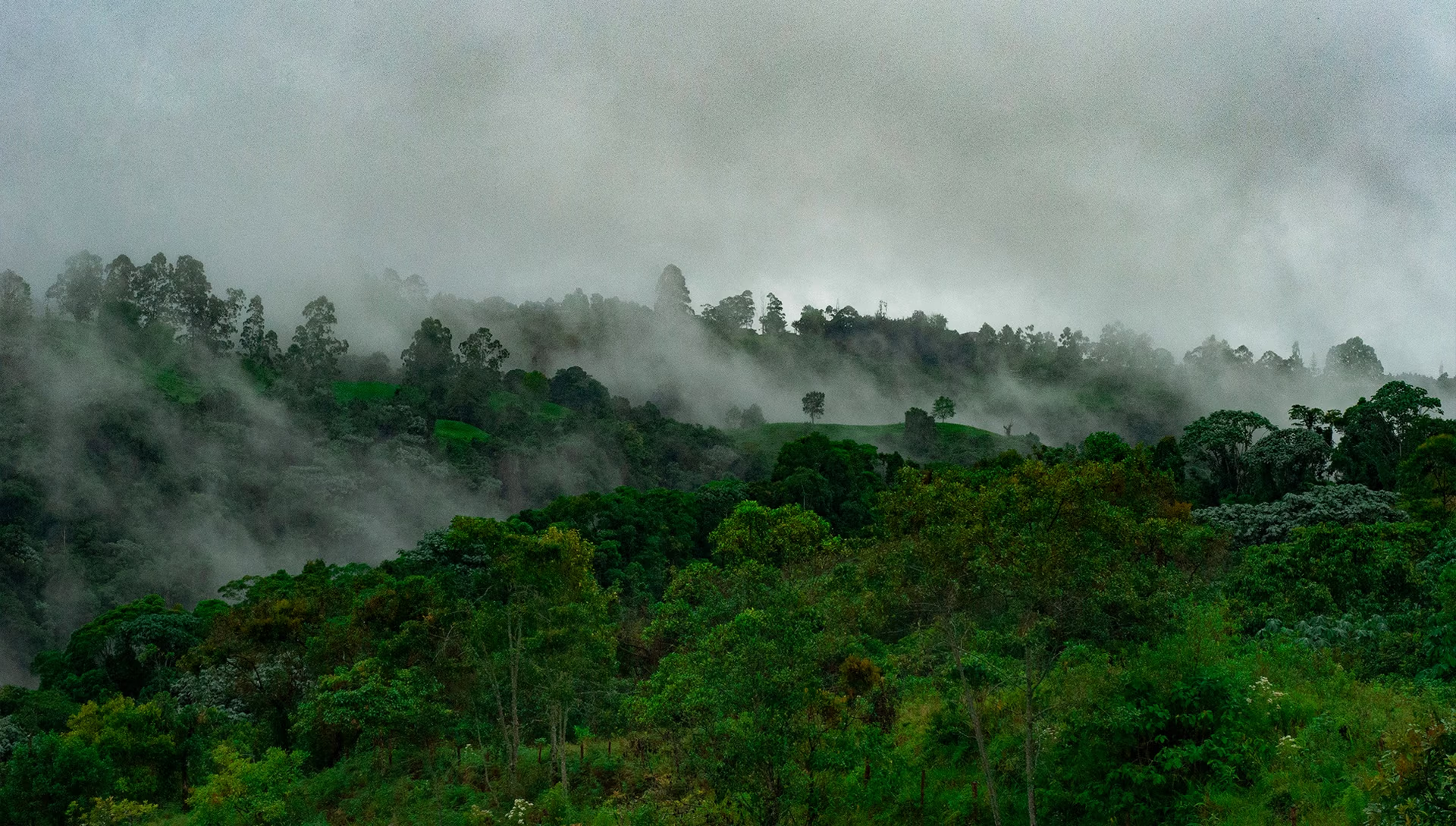
(Cheerful, curious music. Animations with playful graphics that simply explain the natural evolution of a seed. Shots of a native forest in Colombia, showing a great diversity of plants and animals.)
NARRATION: Let us imagine the seed, that tiny point of potential, not as an inert object but as a time capsule. For millions of years, nature has worked as the best genetic engineer, with no laboratories and no chemicals. Through a process called co-evolution, plants, insects, animals and soil have adapted to one another. The caterpillar learns to eat certain leaves, the plant develops defenses against the caterpillar, yet at the same time creates a nectar that feeds the bees. It is a dance of trial and error, in which every living being adapts and refines itself to live in harmony with its surroundings.
(Animated graphics showing how plants adapt to the different soils, climates and pests of a specific region. The NARRATOR’s voice becomes more pedagogical and playful.)
NARRATION: The ancestral farmers of the Andes knew this. They did not invent agriculture; they learned from nature. They saved the seeds of the strongest plants, those that withstood drought or pests, and so, from generation to generation, the seeds grew wiser. The seeds learned to live in that territory, to understand its climate and to speak with its soil. It was a sacred pact, an inheritance of biodiversity that nobody needed to patent.
[03:00 – 05:00] Chapter 2: Chemical Interference and the Death of the Ecosystem
(Dramatic, suspenseful music. Archive footage from 1950s America of the Monsanto factory, the infamous Nitro accident, and the later introduction of Agent Orange in Vietnam.)
NARRATION: But one day, man decided he could speed up the process. He wanted to eliminate the “hard part” of farming: the weeds. With the invention of herbicides such as 2,4-D and glyphosate, a new era of industrial agriculture began. These chemicals promised miracles: clean fields without the effort of plowing and without long days of work. On the labels, they were said to be “safer than table salt.” But history soon proved otherwise.
(Shot of contaminated soil. An animated graphic shows how the chemicals not only kill the “weeds” but also destroy the soil microbiomes, the invisible heart of fertility.)
NARRATION: Just as glyphosate destroys a plant’s chemical pathway, industrial chemicals destroy the intelligence of nature. They kill the soil microorganisms, the ones that transform organic matter into food available to plants. It is as if the soil lost its “teeth” and could no longer eat on its own. Plants become dependent, as if they were in an intensive care unit, and farmers are forced to buy more chemicals to keep them alive. In this model, the wisdom of the earth is replaced by a chemical formula.
[05:00 – 07:00] Chapter 3: The Monopoly and the Struggle of the Andean Seed
(Tense, intriguing music. Images of contracts with fine print. The NARRATOR’s voice becomes more serious.)
NARRATION: The second part of the story was even more insidious. The industry’s solution to its own chemicals was the transgenic seed. They genetically modified seeds to be resistant to their herbicides, creating a perfect monopoly. They sold the seed and the poison, forcing farmers to sign contracts that prevented them from saving or sharing their own seeds. The consequence? Farmers lost their autonomy, their ancestral wisdom, and the diversity of their crops was lost in favor of a single product, a single poison, a single owner.
(Images of peasant communities in the Colombian Andes. The sound of a condor in flight and the wind among the trees.)
NARRATION: The battle for the seed is not a distant problem from another country. It is a problem lived in our Andean mountains. Industrial agriculture has affected our communities, has degraded our soils and has put the memory of native seeds at risk. But amid this chaos, a network of resistance has emerged, an alliance of seed guardians and farmers who refuse to forget.
[07:00 – 09:00] Closing: The Living Memory
(Music of hope and gentle triumph. Images of a community seed bank. An elderly woman teaches a young woman how to identify a seed. A group of children paint in a farm field. Images of the diversity of plants and animals returning to a healthy ecosystem.)
NARRATION: The wisdom that unites us is simple: nature does not need us to correct it; it needs us to listen to it. By caring for the seed, the land and the water, we are not only recovering biodiversity but also our own health. We are returning to an agriculture that is more than a job; it is an act of art, of spirituality and of community. The memory of the seed is alive in the hands of those who sow and tend it. Because in the end, the seed we plant is not only to feed the body, but to water history and cultivate a new way of life.
(Final shot of a handful of diverse seeds, against the backdrop of the Andes mountain range.)
THE END
Deja un comentario
You must be logged in to post a comment
To comment, log in or create your free account.